 LMS-SPADA INDONESIA
Ringkasan Mingguan
-
GREETINGS!
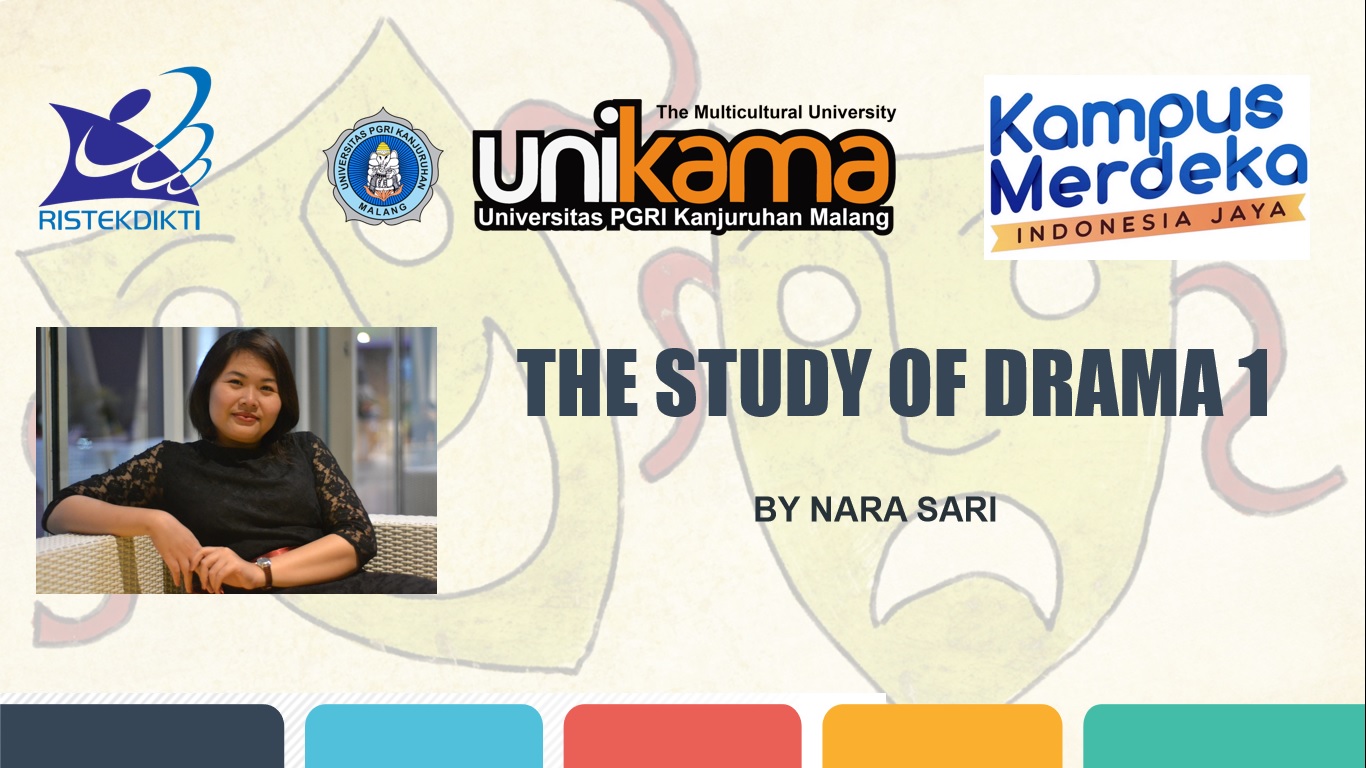
Hello, Students. Welcome to Drama I Class!
Reading and evaluating scripts are as important as performing them on stage. This course aims to help you understand the elements of a play through discovery learning. Through a set of guiding questions provided each meeting, you will be encouraged to build rapport and connect with the playwrights.
By the end of the course, you are expected to be able to connect with the playwrights at an in-depth level and develop a respectful attitude towards an art of work made of words, which is called plays.
You can reach me via email at nara@unikama.ac.id OR send me a whatsapp to 0852-6318-1574
I hope you enjoy this course as I enjoy designing it for you.
-
Let's get to know each other!Tell us a little about yourself! Please include the following:
- Your name and what we can call you
- Where you are from and where you live
- Why you decided to join this course
- Something personal, too -- maybe about your family, your hobbies, whatever you would like to share
You can write all this information in the FORUM (Let's get to know each other) provided
-
Preview
Trifles is a one-act play written by Susan Glaspell, a world renowned playwright and a Pulitzer Prize-winning author of Alison's House (1930). Trifles tells the story of a murder. As you will discover, the "trifles" mentioned in its title are not of trifling stature. In reading the play, you will probably find yourself imagining what you might see on stage if you were in a theater.
Read the play for enjoyment the first time through and then use the questions to guide you to understand and "feel" the play. -
Preview
Trifles is a one-act play written by Susan Glaspell, a world renowned playwright and a Pulitzer Prize-winning author of Alison's House (1930). Trifles tells the story of a murder. As you will discover, the "trifles" mentioned in its title are not of trifling stature. In reading the play, you will probably find yourself imagining what you might see on stage if you were in a theater.
In the previous week, you were asked to read the play for enjoyment and answer QUESTIONS FOR FURTHER STUDY (PART 1) to obtain general information from the play. This week, QUESTIONS FOR FURTHER STUDY (PART 2) will require you to answer the questions from the gender perspective. Thus, you need to focus on gender-based differences in the way the characters reveal and are involved in the case. -
Trifles is a one-act play written by Susan Glaspell, a world renowned playwright and a Pulitzer Prize-winning author of Alison's House (1930). Trifles tells the story of a murder. As you will discover, the "trifles" mentioned in its title are not of trifling stature. In reading the play, you will probably find yourself imagining what you might see on stage if you were in a theater.
In the previous weeks, you have studied Questions for Further Study (Part 1 & Part 2). This week, you are going to share and discuss your answers with your peers.
-
Preview
The Sandbox, one-act play by Edward Albee, published in 1959 (with The Death of Bessie Smith) and produced in 1960. It is a trenchant satire on false values and the lack of love and empathy in the American family. For his expanded one-act play The American Dream (1961), Albee used the characters he created for The Sandbox—Mommy, Daddy, and Grandma— as well as some of the play’s dramatic material"
https://www.britannica.com/topic/The-SandboxRead the play and use Questions for Further Study to help you understand the play.
-
"The Sandbox, one-act play by Edward Albee, published in 1959 (with The Death of Bessie Smith) and produced in 1960. It is a trenchant satire on false values and the lack of love and empathy in the American family. For his expanded one-act play The American Dream (1961), Albee used the characters he created for The Sandbox—Mommy, Daddy, and Grandma— as well as some of the play’s dramatic material"
https://www.britannica.com/topic/The-SandboxUse Questions for Further Study 2 while reading the play for the second time.
-
"The Sandbox, one-act play by Edward Albee, published in 1959 (with The Death of Bessie Smith) and produced in 1960. It is a trenchant satire on false values and the lack of love and empathy in the American family. For his expanded one-act play The American Dream (1961), Albee used the characters he created for The Sandbox—Mommy, Daddy, and Grandma— as well as some of the play’s dramatic material"
Discuss Questions for Further Study 1 and 2 with your peers in the discussion forum provided.
-
- Read Riders to the Sea by John Millington Synge
- Answer the questions provided in the RIDERS TO THE SEA (QUESTIONS)
-
Share and discuss the work you did last week with your peers in the discussion forum.
-
- Watch the stage version of Riders to the Sea provided below
- Discuss your views on the play production in terms of the casting of the characters, delivery of the message, properties used on stage to support the performance, the actors' expressions and gestures or other things relevant to the scripts.
- Criticize the on-stage performance based on what you understand about the play, tell your opinions on how the scripts should be performed or who should play each character. Discuss how John Millington Synge would want his play scripts to be performed.
- Compose a report regarding points number 2 and 3
-
- After watching the stage performance of Riders to the Sea, you have composed a report;
- Share your work with your peers in the discussion forum
-
The material presented this week is adapted from Christopher B. Balme's The Cambridge Introduction to Theatre Studies published by Cambridge University Press (2008). The book excerpts attached below contain "Chapter 1. Performers and actors (theory and analysis, pedagogy of acting and cross-cultural perspectives)". Read the chapter, summarize the materials in your own words and share what you have learned with your friends in the discussion column.
-
The material presented this week is adapted from Christopher B. Balme's The Cambridge Introduction to Theatre Studies published by Cambridge University Press (2008). The book excerpts attached below contain Chapter 2. Spectators and audiences (spectator response, reception and response and audiences). Read the chapter, summarize the materials in your own words and share what you have learned with your friends in the discussion column.
-
The material presented this week is adapted from Christopher B. Balme's The Cambridge Introduction to Theatre Studies published by Cambridge University Press (2008). The book excerpts attached below contain Chapter 3. Spaces and places (theatrical space, stage space and the place of theatre). Read the chapter, summarize the materials in your own words and share what you have learned with your friends in the discussion column.
-
Read the play and answer Questions for Further Study
-
Fill in the self-evaluation form provided below to examine your performance during this semester
 LMS-SPADA INDONESIA